

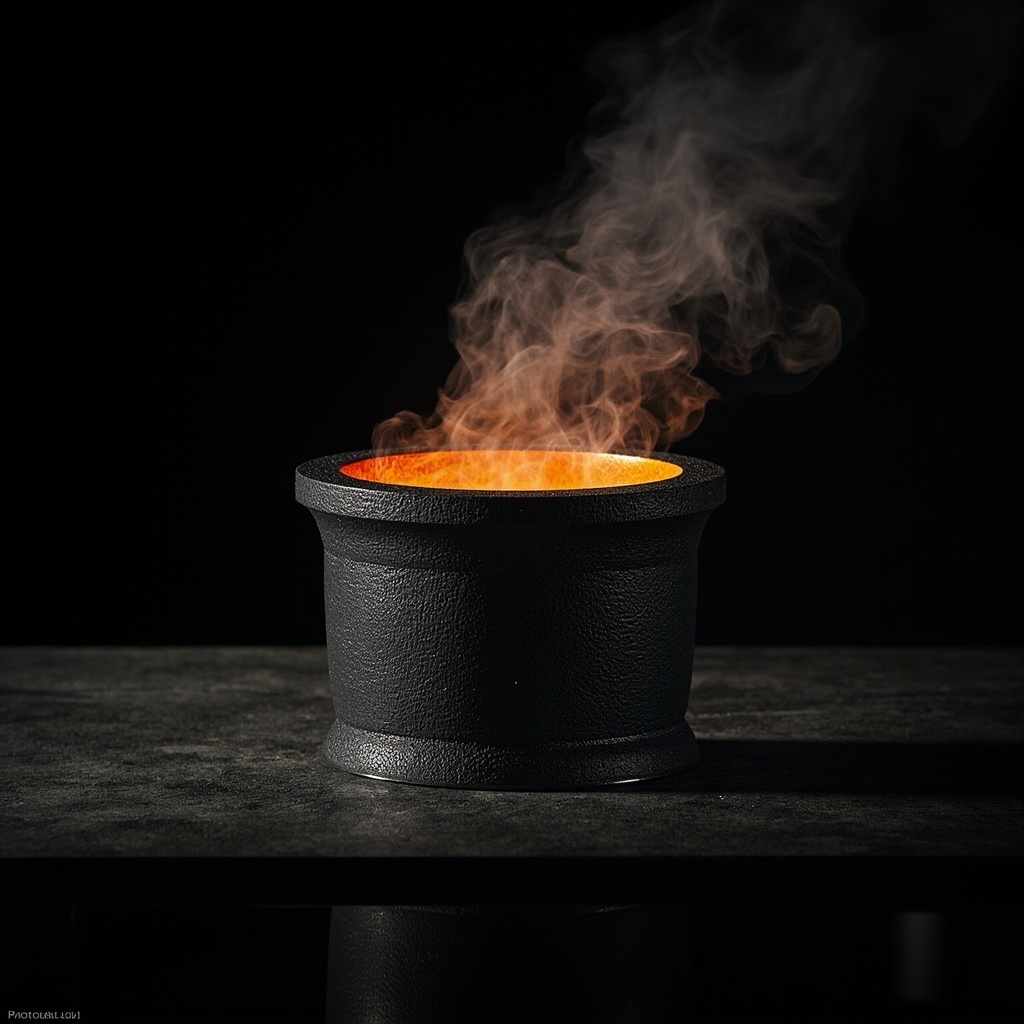
 You don’t pay a metallurgist to stir the pot. You pay them to ensure the pot doesn’t ruin the gold. That’s the brutal reality of precious metal alloying: one stray particle, one microscopic impurity, and a batch worth tens of thousands of dollars turns into scrap. The culprit? Often, the crucible itself.
For years, the industry tolerated contamination. We accepted that a standard crucible would leach silica, iron, or carbon dust into the melt. We built entire quality-control protocols around fixing what should have never been broken. But there is a better way. It’s called the High-Purity Graphite crucible, and it’s changing how we think about the “uncontaminated melt.”
Let’s talk about what “high-purity” actually means here. We aren’t talking about the cheap, porous graphite blocks that crack after three cycles. We are talking about isostatically pressed, ultra-fine grain graphite with an ash content below 20 parts per million. That’s not a typo. Twenty parts per million. In a standard crucible, the ash content can be ten times higher, and that ash is exactly what ends up floating in your 24-karat alloy.
Why does this matter for alloying? Because precious metal alloys are finicky. When you blend platinum with palladium, or gold with silver, you are chasing a specific crystalline structure. Impurities don’t just discolor the metal; they weaken the bond. They create micro-fractures. They ruin the electrical conductivity of a gold bonding wire or the hypoallergenic properties of a platinum ring. A high-purity crucible eliminates that risk at the source.
But here is the part the marketing brochures usually skip: thermal shock resistance. Precious metal alloying isn’t a gentle simmer. It’s a brutal thermal cycle. You heat fast, you hold, and you pour. A low-grade crucible shatters. A high-purity graphite crucible, with its engineered density and uniform pore structure, handles the heat like a champion. It doesn’t crack. It doesn’t flake. It delivers consistent thermal conductivity across the entire wall, meaning your melt is even. No hot spots. No cold zones. Just a clean, uniform liquid ready for casting.
And let’s not forget the economics. A cheap crucible costs less upfront. But it also contaminates your melt, forcing re-melts and chemical refining. It breaks mid-cycle, shutting down your furnace. It wears out faster, requiring constant replacement. The high-purity crucible? It lasts longer, performs cleaner, and protects your material integrity. The math is simple: you aren’t buying a crucible. You are buying insurance for your alloy.
So, next time you watch that glowing metal pour into a mold, ask yourself: what was in that crucible? If the answer is anything less than high-purity graphite, you are gambling with your gold. Stop gambling. Start melting clean.